Posts tonen met het label loneliness. Alle posts tonen

vrijdag 31 mei 2024

Addressing myths and misconceptions surrounding loneliness

Loneliness is depicted by media outlets and social networks as:
- Intense sadness;
- Social anxiety;
- Social awkwardness;
- A low sense of self-worth and even self-deprication;
- The need for reassurance and validation;
- Feeling invisible;
- Depression

I am vocal about addressing the myths and misconceptions surrounding loneliness. Why? I don't match any of the abovementioned "characteristics" to depict loneliness. 

Much as I am open about loneliness and even though I share a lot with a wider audience, I simultaneously sort it out myself. With that I mean I never cling on to people. I don't want a man, a boyfriend, to resolve my loneliness. I want company because I enjoy being around people I can get along with. I don't see others as means for filling the big gap of loneliness in my life.

I am the opposite of a recluse, I never experienced feelings of inadequacy or social anxiety, not even in adolescence. On the contrary, I have always had a strong and balanced sense of identity and I have never been held back by anything or anyone. I have always stood my ground in the worst circumstances. I never second-guess my decisions. I am not prone to worrying. I am even easy, I like inside jokes, practical jokes, I am a total goof. None of the clichés surrounding loneliness applies to me.

I never compare myself to others, nor do I feel like a misfit. Not that it is decisive in loneliness, but I don't have an introspective focus. I am good at chitchat, I like to talk to strangers. Making friends and meeting people is easy for me and I feel best in lively surroundings. 

I don't feel rejected; the popular "I never fit in anywhere"-myth is not how I experience loneliness at all. I don't care what other people think of me, I am authentic and do not feel the need to be liked by just everyone. 
None of this means that I am a snob, although people sometimes tell me that they thought I was an elitist when they first met me. Just because I don't want to mingle with everyone, doesn't make me arrogant or standoffish.

What describes me best, is that I have a straightforward personality. I don't need euphemisms and I am vocal about my emotions. I am the opposite of people who exhibit passive aggressive behavior; if something's bothering me, I like to address the problem directly. This does not imply that I am not tactful. I am. I can go out of my way to not publicly shame a person or make them look awkward, but not out of forced politeness or moralism. People do view me as spirited/temperamental and impatient and that it why I tend to be avoided by some.

What loneliness means to me
I already said that I have an easy time meeting people or making friends. My loneliness is rooted in two phenomena:

- I don't have a family left. I am not subjectively lonely, but objectively. It is not just perception; I don't have loved ones because my loved one is dead. I do know that I am a Slavic person with Asian ancestry, but I don't know where the rest of my family resides, as our family history is ruined by false adoption and assimilation (my family name was erased. Attempts to track my family through the autorities in The Hague, were to no avail);

- I experience situational loneliness. I do have friends that I can trust, but they live too many miles away from me. In my neighborhood, I can't find meaningful connection because most of my peers don't share any interests with me. I have a few neighbors I have spent days and evenings with, but most of my fellow citizens (peers) prefer binge-watching Netflix, frequenting a takeaway for fastfood or gambling. I am talkative and outgoing.

I feel drained when I have to be alone, at home. It is not that I can't stand my own company, it is not how I was wired; I need buzz, like a bit of chaos, noises, people to chat with and I have a very high physical drive.

I need equal and fulfilling connections. Sharing the same kind of energy, sharing values and interest in life is important to me.

I love it when people are interested in a broader range of topics, not gossip fitness or your latest Netflix watch. To be honest, I would not be able to create satisfying connections with lonely persons who spend the day on the couch or in bed, binging Netflix series or reading chicklits. It's not that I would not be able to like/love them, but I have too much energy to resonate with them. In other words: "Anyone will do" does not apply to me.

I also have a profession with important stakes (privacy) as well, I need people to respect that. My friends, who are a scientist, a pharmacist and artists, understand that. I can't share much about my work when I strike up a conversation with acquaintances or during a party. People sometimes get the impression that don't want to talk about my work, while I can't and won't share the "juice".

The assumption that lonely people are a bunch of sad people in despair, is plain wrong. Being lonely can be due to various reasons, one of which is situational loneliness. Being lonely does not necessarily create companionship between two lonely people, or even in a group. Compatibility of personal traits, intellectual capacities and interests are common factors that are pivotal to create meaningful connections. Not two people will resonate just over being lonely.

Why is it wrong to assume that loneliness is the same as depression?
While loneliness can bring about depression and unhappiness, the root of depression is different, as are the symptoms. From a personal view, I have had a few friends with mood disorders who did not feel "just sad", but reported a persistent lack of energy. Apart from a severe lack of energy, depression can be characterized by persistent feelings of hopelessness, self-doubt, worthlessness that infringe with daily activities. A person with clinical depression might not even be able to get out of bed, dress up, go grocery shopping or to go to work.

People with mood disorders may report feeling persistent sadness without external factors.
These symptoms don't align with loneliness, which is a lack of adequate relationships at the root of feeling unfulfilled and dissatisfyed.

Is normalization of loneliness the solution?

No. First of all, normalization of a hurtful emotion as is loneliness, differs from learning to live in solitude. Some people may adapt to solitude easily and not feel lonely. Telling lonely persons that "being lonely should be normalized" is telling people to adapt to persistent negative consequences of loneliness.

Time alone is not a blessing, nor an opportunity to find fulfilment of one finds meaning in connections with others.

What is the difference between situational loneliness, perceived loneliness and codependency?
Situational loneliness occurs when opportunities are missing to find meaningful relationships. This type of loneliness is not confined to perception; poverty, chronic illness, separation, deceased loved ones and even the environment (the neighborhood) contribute to actual and even absolute loneliness. 

Perceived loneliness if the type that a person experiences even with good friends. Codependency means that a person needs company for affirmation and reassurance.

Why is it harmful to push lonely persons into solitude?
Humans in general are designed to communicate and cooperate with fellow human beings. One would deny the design of the limbic system, even, when saying that solitude is a natural way of living. There is a neurological reason for the need of meaningful connections.

Some may prefer solitude after a string of bad relationships. It does not take away from the fact that most people need fulfilling connections. One cannot compare these two entirely different positions. "It is better to live in solitude than to have a bad relationship" and "I need meaningful connections" are not two opposites; a false dichotomia is popularized to favor solitude. Enjoying solitude for a while after a bad relationship might be a retreat and provide relief, but it does not mean that lasting solitude stimulates one's wellbeing.

Above all, you have to be wired for solitude to actually find joy in solitude. This does not apply to people who love to be surrounded by company (even at all times). Individuals who draw their inspiration and energy from activities with other people, will feel underwhelmed, uninspired and drained when having to live in solitude. This does not mean that they are "weak".

Self-support groups in the internet community promote the normalization of loneliness. Why is this toxic behavior?

1. Loneliness is stigmatized as "Just a mindset"

The complexity of emotions, the negative impact of loneliness and the basic human need for meaningful relationships are reduced to a state of mind that one should just "think their way out of". The dynamics of human relationships, personal needs and suffering as a consequence of loneliness are dismissed. The stigma of "Loneliness as just a mindset" dismisses the human sense of belonging and need for support in life. As a result, a lonely person might even be ashamed to address the topic of loneliness as support groups suggest a weakness of mind.

2. Lonely individuals are dismissed as "Persons who can't enjoy being alone"

"If you don't like being alone, you are in bad company"
"If you learn to enjoy your own company, you'll never be lonely"
"People who need other people, are just dependent"

These stigmatizing views are an oversimplification of the multifaceted phenomenon of loneliness.
A basic human need for meaningful connections is discarded as dependency.

Suffering from loneliness is dismissed as "lacking self-worth", thereby invalidating genuine emotions and personal preferences. People who are wired for company, are not reliant on other just for finding joy in meaningful connections. Not finding solace in solitude does not mean that an individual is unable to enjoy their own company. In other words, it does not mean that a person who does not find solace in solitude, depends on other people for affirmation or reassurance.


Harmful positivity: people are pushed to enjoy loneliness and solitude and if they don't, they are depicted as losers who are dependent on validation by others

dinsdag 11 juli 2023

[Loneliness among the young] I was forced into being lonely and socially excluded by peers while I never wanted to. My peers have always regarded me to be competition and often too intelligent- I can't change their prejudice

I asked A.I. to explain my loneliness. I took to A.I. for psychological advice. What the bot said, was pretty accurate.
I asked:

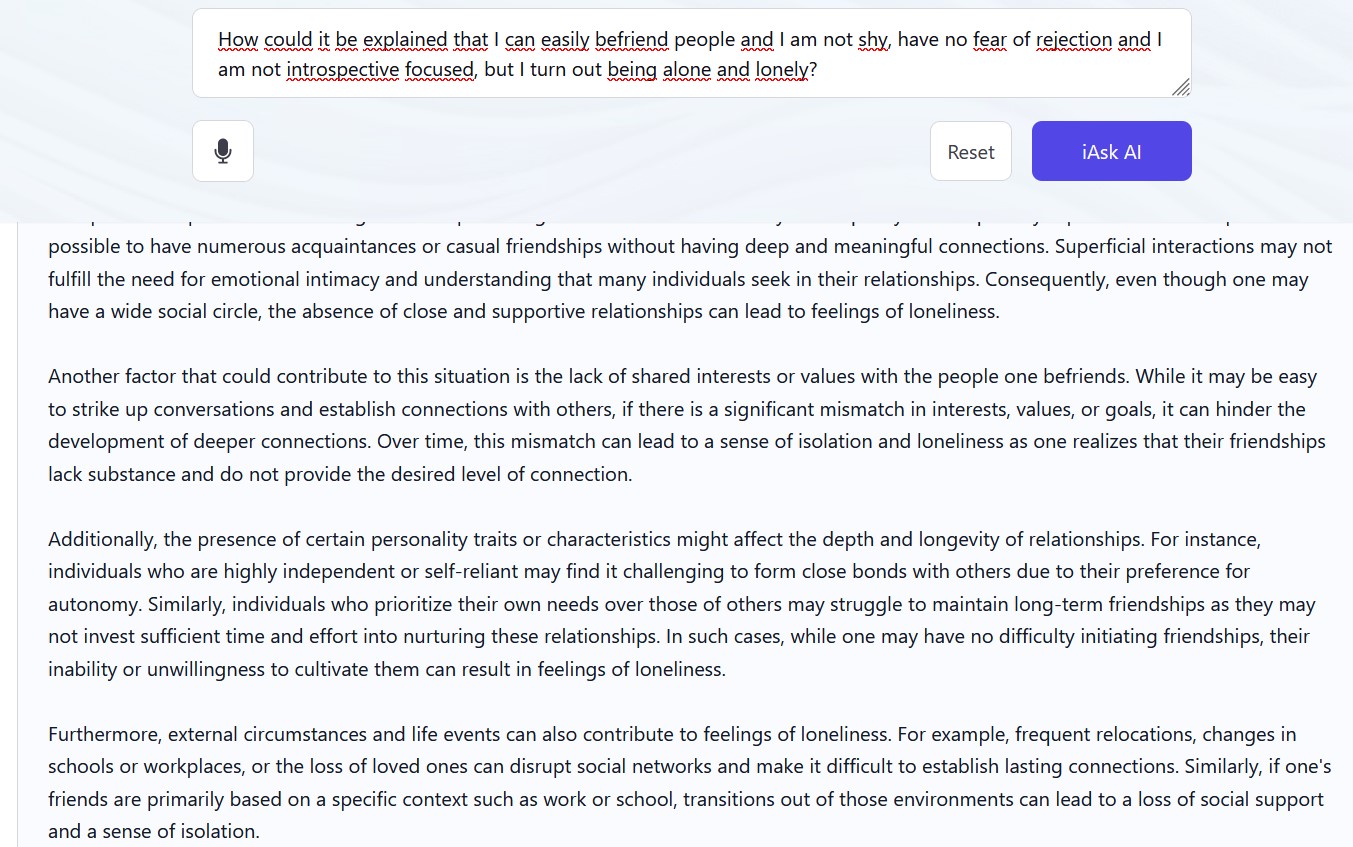
"How could it be explained that I can easily befriend people and I am not shy, have no fear of rejection and I am not introspective focused, but I turn out being alone and lonely?"

Because, I never drew back, I reached out, I never clawed up, I am not one to hide myself at any time, it's not an inability to form relationships, but none of this alleviated my loneliness.


Yes: A.I. explored my loneliness! According to A.I., my loneliness likely is rooted in a lack of meaningful connections, a lack of shared interests and values with my lots of acquaintances, while my independency and situational loneliness further deepen my lack of meaningful relationships.

I know what does contribute to my loneliness. My female peers still view me as competition in adulthood and people who meet me suspect that I am highly gifted. It is a common popular myth that gifted people are introspective-focused or fail to use their social skills. The opposite is true, but that's not what it's about. The harshest myth surrounding giftedness that severes loneliness, is that gifted people are arrogant, standoffish and too easily done with people.

It's different: not being able to carry out their full potential means that gifted people will not meet sufficient likeminded peers. But for me, as a female, I foremost have to combat the stigma of looking like a seductress to others. I never saw myself as a siren and I am not a player, but I have literally been called "those tits", "attention whore", "sex-bitch", "overdone looker", "anorexic", "slut" since hitting puberty at age...7.  

At age 7, I was not going into thelarche, but full stage 3 and 4 development. I had a cup B when I turned 8 and my teacher told me "hide your tits" and dubbed me "everlasting cleavage" in class.

It still happens to me that someone notices me upon entering the room and decides within a second that I am competition
Two weeks ago, I was at a meeting. That night, as I entered the conference room, a woman elbowed a woman my age, next to her. She pointed towards me and started whispering. She started checking me out, from top to toe, my dress, my face, my hair, the way I was talking to other people I just met. She took a seat beside me. And all the while she was staring up and down. I caught her gaze every now and then. She refused to share a word with me. She had decided that I was competition from the second she noticed me. A competition I hadn't asked for. There is no good reason to lock me out of companionship, but this is my reality: it happens to me very often that I get no peers to talk to because they feel I will be competition.

'You look every inch the popular girl'
This is not to say "Oh wow, look at me, I am so perfect".
I have been told that people assumed that I was the popular girl. They assume that if you're considered pretty/attractive/beautiful by others, you will be popular among (female) peers. The opposite is the case.

As a girl aged 5, I have been assaulted by a 12-year-old. She attacked me because she hated me for looking like a girly girl- "A Barbie doll". She gave me a bleeding ear and a swollen jaw. I did not cry, I didn't even panic. It was just when I returned home that my mother discovered my injuries and stepped to said bully's mom, who admitted that her daughter assaulted me because she was tremendously bullied by peers for "resembling a butch".

In elementary school, I was again assaulted when I turned 6. This time, my bullies were three girls who were preparing for secondary education. I had never seen them, they came out of nowhere. I was not scared of them, but me defending myself was considered offensive. I called a teacher in and told my bullies to admit that they had assaulted me. My teacher told me to keep it to myself! I would only evoke more hatred should I stand up to these bullies, who were much bigger than me. I would not stand a chance when they would use their full body weight to sit on me, all three of them.

My mother would find out that the bully's leaders' mother was the one who had tried to hit my mother with her car when my mother was riding her bike with me sitting in the back of her bike. That woman came driving onto the cycle path to strike my mother's bike. My mother could only avoid being ran over by the car by getting of the cycle path immediately. The bully's leaders' mother was the personification of trailer trash. She envied both my mother and me: my mother for being attractive and me for being intelligent, loved and being viewed as the pretty child whereas the bully's mother did not appreciate her own daughter. Her daughter was called "The Pug" and "The Stupid One" by her classmates. It turned out that after 6 years of school, my bully was still illiterate and struggled academically. She would go on to become a teen mom with a violent husband who was openly known to cheat on her.

Bully behavior is often initiated and nurtured by crazy moms who are deeply envious of other mothers and their offspring
These mothers in elementary school were really crazy, nasty creatures. A mother had torn my new coat to shreds with a pair of scissors. Another threw a whole carton of chocolate milk over me (I never drank chocolate milk, hence it made no sense she even walked up to me to "spill" chocolate all over me).
Elementary school is meant to mix the offspring from people of all social classes and cognitive capacities, but it is just no good. To me, nothing positive stems from formal education. 

Our school system was based upon the formation of groups. In class, we were appointed a place within one of 6 groups. I clashed with three of these groups and when I finally befriended one of these groups and enjoyed chatting and joking all day, I was punished by being promoted back to the group of girls I argued with every single day. None of these classmates were really bright. Some of them were kind, but the "popular group" was just plain unintelligent and sluggish. I was assumed to be gifted and therefore a threat to others. From age 3 until now, I have on several occassions been confronted with the question whether I am truly gifted. That explained why I had no lasting friendships from school.

On a side note, it is not me who is particularly concerned with the question of being highly intelligent or gifted. I tick many of the boxes of giftedness. But the only thing important to me is finding a likeminded mate in life. Someone I would not have to inhibit myself for, who I can feel truly myself with, without a major discrepancy between our worlds of emotion, cognition and action.

Bullying: powered by teachers, even by bully-teachers

Like I said, I was never one to be scared of bullies. I even drew the attention to me because I stood up. I have always been an assertive child. I immediately reported the bullying to the head of the school, but he assured me that I should not stand up against bullies, for I would have it coming to me.

1. Bully victims are told they should adapt, but they are not the ones who should change themselves our their behavior. Those who say "You should become assertive" are mostly teachers who do not condemn bullying behavior but instead turn the focus on how the victim should behave. Those enablers, teachers who to nothing to expel bullies, are the problem.
2. Everyone is discouraged to stand up against bullies. This applies to those defending themselves against mature bullies as well.

If the teacher is the bully

In pre-academic education, we had to deal with a severe bully-teacher who called out his students in class. He even humiliated a classmate in front of us. He used slurs and threats.
I took the initiative to report his bullying behavior. The Dean refused to pick up my complaint.
The other day, other students went to the Dean's office to submit their complaints on this teacher's abusive behavior. He had used harmful tropes. The Dean told all of us that we would severe our already strained relationship with this teacher.

There he was, at our graduation party. He was seated next to the Dean. These phony people put on their fake smiles to celebrate their wonderful experience in teaching.

After elementary school and throughout adult life: "You have it all going for you". Well, that is a good excuse to single me out...
I was never bullied by my own peers or classmates. Apart from these 2 incidents, I was never even openly bullied. It was rather subtle. Since high school, I was socially excluded by my female peers. I was considered to be forward, intelligent, high-class, high-minded, but also competition.

From my early days in high school (I was 12), girls had passed on to each other that I was doing modeling jobs, but also that I was a ballet dancer and an athlete. I had no clue how they had come up with these ideas, but I was judged upon my appearance. Yes, I looked athletic and yes, I had model proportions. I did not do sports or fitness. I never had to follow a diet. These peers probably thought it was justified to outcast me, since (they said) "I had it all going for me": 'Yeah, you. You have no right to complain'.

"You have no right to complain"

I had girls come up to me and pluck my face or touch my brows because they thought I was wearing makeup. They pulled at my hair because they thought I had extensions. The envy deepened when they learned I never wore makeup. I had one friend trying to trash my neck chain because she thought I was wearing genuine gold jewelry. Classmates looked up were I had bought my clothes. I got comments on not wearing what they were all wearing, like I was looking down on their looks. I did not join fashion trends. I was considered too "fashion-forward" for having my very own dress sense.

I learned later that "friends' had talked behind my back: they had made up that I had silicon implants and that I underwent plastic surgery. The secretly called me 'anorexic-with-tits". I was called a slut and a maneater since the age of 12. Girls felt it was a good excuse to outcast me because their male friends liked me. I got along with the boys well. I shared their interests and their sense of humor. I was into biology, math, but also computing and doing odd jobs.

My female peers called me out for being a "seductress". I was not even concerned with coming across as attractive. I never considered myself to be there to please the boys or attract male attention; I was interested in intelligent topics, like science. I was interested in men, but not just anybody. I wanted a creative, intelligent and mature boyfriend who would be uplifting instead of those blokes who relied on the gain of popularity.

I was finally outcast when so-called female friends my age witnessed me being sexually harassed by a commutor on a train ride. They decided that I had provoked the attention of men. Upon graduation, I was completely ignored by my female peers. They called every female classmate in for the final gathering. Even the girls that were considered the loners were called in- except me. Instead, a father of a classmate embarassed his family when he started taking loads of pictures of me in their presence. He called me "Princess Snow White" while his wife was seated next to him and left his seat when I had to pick up my diploma. It was downright bizarre.

People claiming entitlement are a major problem: I wasn't even allowed to join discussions with bully victims, since "I don't appear to have been a target"

You'd think that coming off age will make a difference, as people mature. But adult life had been not any different for me when it comes to social exclusion by female peers. I have had my fair share of male friends. On one side, I lost male friends because they wanted more than friendship, thus ruining the friendship bond. On the other side, I lost my male friends because their girlsfriends/fiancees/wives did not agree upon our friendship.

During college, we once discussed bullying and the impact on bully victims. The discussion was awful, as it left me with further exclusion: bully victims told me "You have nothing to complain about".
Complaining is not the point. It meant that everyone was entitled to be a bully victim, unless people think you have everything going for you.

I literally resent my life engraved by loneliness, zero luck and suffering a tremendous loss- but people still exclude me for coming across as someone "who has it going for them"
I noticed that there is zero sympathy for people who are considered by others to have everything going for them. Like I said, if I tell people that I have never had female friends since age 12, it is considered a complaint instead of an illustration of how social exlusion can work out.

My mother has had cancer 5 times. The first time was when I was still a child in elementary school, the second was when I had just finished secondary school and the third time was when I graduated from university. All of these times I had no social network to rely on. I had no one to talk to. The second time she was hit with cancer, I shared it in class, but peers assumed that I could cope by my own. The fifth and final, fatal time was 1 January 2023. An awful time. Again, even in hospital I was treated harshly because the manager felt envy when she met me. She told me that I could see for myself. I requested help and was denied of any help. In the palliative unit, people also assumed that I probably had friends to share my sadness with.

On the night of my mother's death, I either had to take all of our stuff with me to return "home" by public travel or I either had to call a cab. No one was there to help me get home at 11:30 P.M. I had people tell me it would be inhumane would their family members had to travel home all alone after the loss of the most important person in their life- well, here I am.

You know what hurt me the most and will haunt me until my death? My mother and I were alone in this and I was the only one to see her in het coffin.

My mother, like me, had no problems befriending people but she was a lifelong victim of female envy and stalker behavior by men who saw her. My mother was not even allowed to visit her closest female friends once they got married. They were concerned that their husbands would fall in love with my mother. Well, it happened. The husband of a befriended neighbor of us told my mother that she was secretly the love of his life. She was shocked. She did not know what to reply. The husband of our neighbor next door sneaked into our yard at night. I was still a toddler. When I heard something and asked where that sound came from, my mother looked out of the window, straight into our neighbors' face. He got stuck between the conifers and yew. My mother wasn't even allowed to visit birthday parties anymore.

I dare to say that the life of a female who is considered a siren, a seductress, charming, witty, intelligent, wise, can be greatly hampered by female envy. Sadly, those around envious women do often go along with their behavior.

That means that the envied one will end up leading a lonely life. I do. People still assume, after my loss and with zero support, that I have everything going for me. I don't say I want to trade my life with anyone else. But I hate my life very much.

Dropping a photo load of mindless reflections

I'm just going to show you what I look like. I have never been volptuous. Standing 1,77 1/2 metres tall, I am not very tall, neither short. However, I am usually taller than the people I meet and I have always been the tallest in class and college. I was not teased with my height, but I have a natural low Body Mass Index (I have been 55 kilograms since age 13, when I was 1,75 m of height) of 17,9 at most and to this very date, women like to spread the rumor that I am anorexic.


I've always had to double my food intake. This is me at my fullest. If I lose weight, my bones stick right through and it hurts to just sit down


That there, is Kid Amnesiae. My favorite Radiohead disk, next to TKOL. You should listen to the entirely orchestral "How to Disappear Into Strings"; a Masterpiece.

This is me demolishing the outdoor table. I don't have pants, workwear, jeans, homewear or sportswear


This is my favorite dress. I have had this since age 15. Since the upper piece has become a sheer cotton from aging and washing it almost weekly, I only wear this at home

I would have loved this to be a totally white cotton dress


I am a natural cross between an athletic build and a pear. This is what I look like not doing sports or fitness. To be honest, I think it's crazy that I have often been called out for being the "seductress" while I am not voluptuous. Some men even openly found my protruding hip and shoulder bones and knuckles creepy.


Sometimes I feel like looking trashy. Around the house. I will not leave the door like this, with legs completely revealed. Very short dresses are never elegant


Here I am wearing eyeshadow and just a face cream. I was told I looked plastic. I am not looking into the camera because I have very light-colored eyes. They are sensitive but also turn red on pictures if the camera flashes into my eyes.


maandag 27 maart 2023

[ Loneliness and living on with no family and loved ones left ] Having no family: how assimilation of an extremely small migrant family hit me, as the only remaining member

I never knew that it wasn't that normal to have no extended family, until I learned from the false adoption history affecting my grandmother, my mother and ultimately me
I never thought that being the 3d generation of an extremely small family of migrants would have hit me like this: it means that I am the only remaining member in my country of residence, the Netherlands. During my formative years and adolescence, I never heard a word about my actual ancestry. As a child, I just assumed it was normal to have no extended family on my mother's side. But I was at times surprised to see my Dutch peers with their huge extended families during anniversaries and birthday parties. Little did I know that (speaking from mitochondria) were weren't very Dutch.

My grandmother was put up for a false kind of adoption. She was assigned a Dutch name. To prevent my grandma from becoming an heir, her foster mother refused legal adoption, even though her foster father was planning to adopt her. The dispute arising over her "foster mother's" unwillingness to grant my grandma legal rights led these foster parents to put my grandmother into a children's centre.

The Netherlands denied a residence permit and refused to guide the remigration process
Her biological father was either a refugee or a labor migrant from the Soviet Union (pre 1990). He had to relocate to the USSR when he was not granted a permit to reside in The Netherlands. What my grandmother did know, was that her father had formally requested to be reunited with his daughters. The Netherlands did nothing to orchestrate a remigration programme for these migrants' children.

Not only did The Netherlands refuse to guide remigration procedures; our actual family name and language were erased as well. No trace was left for my grandmother, my mother and me. That is what assimilation is like: it is not inclusion by any means to cut people off from their family ties.

I am the only remaining family member in The Netherlands. Our family dies off with me
Well, here I am. I am the only remaining family member in The Netherlands. I don't know who my relatives are, I don't know where they reside, I don't even know our actual surname. I can't compare with family members to know if we have personality traits in common. I will never know if they are as impatient and talkative as we were. I do not know whether they are as articulate and strongly opinionated. I guess so. These are traits that defined my grandmother, my mother and me.

Since the loss of my mother in February 2023, it hit me really hard to have no family members left. With me as the only link between The Netherlands and our country of origin, this small family dies off. I have no children, no family of my own. It is an actual burden to live for me alone, I absolutely dread getting old without family. I despise the prospect of living for myself. It's not self-pity. I don't enjoy my life as a standalone. A strong family bond is what I valued ánd wholeheartedly enjoyed in life. People from West-Europe may maintain that individuality is the highest value in life, but that is just an artificial way of denying life's purposes as a social species. There's no need to dispute that, as if there was a purpose to live life for one's own. Being literally alone is hurtful. My mother and I had a strong bond. I would have wanted to know whether our relatives have something in common.

Every once in a while I have to repeat that my mother and I had no family. People often assume that other people have family members to help them through bereavement and the many tasks involved in settling the inheritance. I don't think my position is completely unique. But I do have to emphasize that either remigration programmes (and therefore family reunion in the country of origin) or inclusion are indispensable for the wellbeing of subsequent generations.

What still hurts me to the core: with such a small family and health care assistance being denied systematically, each of us had to depend on each other for extensive care
My grandmother died young, her sister died even younger, my mother had the same prospect when she was just in her thirties. Since my grandmother had her daughter as her sole family member, she had to depend on my mother when she suffered from gynaecological cancer that had metastasized. It was severe.

The same hold good for my mother. My mother was denied professional health care following her first cancer surgery and during chemo and radiation. As a child going to elementary school, our government expected me to provide my mother with health care. Three times more I would be the caregiver. I never felt it as a burden to care, even if it would become physically straining. Years before her first primary cancer diagnosis, she had suffered dangerous pregnancies. As if life hadn't hit her hard enough, I was the only one in her life she could depend on.

In January 2023, my mother became paralyzed due to brain tumors. After intracranial surgery, she would recover for a couple of weeks, until the tumors had grown. It is good for nothing to see someone full of life and energy become bed-ridden, not being able to pick up the phone, call me, not being able to sit up in bed, not being able to pick up a drink. I had to take care of her fully, but I also had to visit home every now and then to take the mail and do her laundry. I had to walk 45 minutes to get to the bus. With all of this heavy luggage that I had to take to the hospital and the palliative unit. And I thought: it would be absolutely terrible if something happened to me right now, or if I got stuck in a huge traffic delay while she could not even pick up the phone. It is bonkers to have no assistance in such a situation. And I did request professional assistance, but again we were denied of care. 

I am vocal about never being offered any kind of (medical) assistance in our vulnerable position, being two family members without the support of an extended family, immersed in severe health crises and their accompanying grief, all by ourselves. Even while being vocal and concise about the need for assistance, I was denied of it. People tell others "One should not endure health crises and grief all alone", well,  that is what happened to us for two decades and still happens as of March 2023. Right now, no one I contacted had offered me any kind of assistance. Most people don't actually invest in the wellbeing of others. It's not that they "go on with their lives". Most of them just shut off, hide in their homes and never question how others will find their way without support of a family. 

vrijdag 24 maart 2023

[ Loneliness #1 ] Loneliness is a legacy left unknown

You cannot address loneliness with ill advice, "explanatory blame" and stereotyping
Let me speak from personal experience. It is not such a hot topic to speak about loneliness when being young. I haven't spoken about loneliness because I deliberately avoid ill advice, clichés and blame. I am not looking for someone pointing a finger to character traits that might be to blame. Certainly, I don't even know why I have been alone ánd lonely for a great part of my life.

I don't mind exploring dark themes like loneliness, a topic that none of my peers has ever welcomed to discuss openly.
I absolutely despise the thought of ever getting old, living my life just for myself alone. It is a curse. No one should try to convince me that life is worth living for a purpose if I have to live without strong social bonds. Being alone is not rewarding, not comforting, it's the opposite- it is cold and empty. May I ever succumb, it is not due to being depressed- it's due to being done with being alone for no good reason.

Now, I have no remaining family. Since the loss of my mother on 18 February 2023, I have literally been all by myself, to this day I have exactly no one to resort to or share my feelings with, even though I am an expressive, honest, not-so-easily-offended and talkative person. I know myself well. I know that I am not one to hide myself and douche myself in darkness.

I do resent those people who have always assured me that I should just "Call whenever you need me, I'll be there", were "too busy", whilst they were most likely just watching tv that Saturday night, when I had to return to an empty house while there would be no one to talk to in the upcoming weeks or even months. Those people who assure you they will offer you help amidst dark times, they just don't care or they experience fear themselves. Fear to deal with bereavement.

I really hate posts beginning with "Loneliness is perception", and clichés like "Loneliness does not equal being alone, it is just a feeling". I am not looking for useless advice either. You've probably heard:

"Reach out to people".
"Loneliness is a sign that you should seek connection with your friends and family".
"Go make friends as soon as possible".
"Go volunteer. The elderly need help too".

People who take these clichés into their mouths: do you really think that a lonely person didn't reach out or had been trying to make friends? Do you think that pushing a cart and serving drinks in an elderly home solves loneliness amongst either the young and the elderly? Likewise, the ill-founded kind of "advice" to "avoid stress" is a truism. If loneliness brings one to the edge, how does one avoid being severely affected in their wellbeing?

Stereotyping makes things worse. The typical lonely girl/boy/woman/man is depicted as a depressing, dark-minded, isolating, not fun, heavy-hearted, energy-lurking individual.
When it comes to personality traits, the lonely one is a shy or either standoffish arrogant being, a pathetic people-pleaser, unsociable, not reaching out, social cue-lacking, thinking highly of themselves or downtalking themselves all the time. Something must turn other people off.

How loneliness hit me in the face

Hence, I don't have an explanation for loneliness. It's not that I would feel embarrassed to talk about this openly, but I never, literally never want to hear ill advice, clichés and stereotypes.

In my youth, I was hardly ever alone. I enjoyed being surrounded by friends my age all day. I did not enjoy introspective activities like reading or drawing in my room. Times when I enjoyed drawing, it was when I was together with at least one friend or a group of children from my neighborhood. Most of my youth I was spending time with a friend outdoors, doing some pretend-play or playing games in the backyard (Yes, it was the Age of Internet, but we were not allowed to use the internet and I am quite greatful for that. It was hilarious and even a bit exciting to secretly browse the internet while our dads were at work, only to get busted by the internet history not being erased). Many times my backyard or the living room was really crowded.

These childhood friends went to other schools and I haven't seen them since high school. In high school I was very talkative (..) and I rarely had a moment of not chatting with a classmate next to me or cracking jokes with a classmate at the back row. I did not like school that much, but I enjoyed the fun we had.

After high school I was faced with loneliness for the first time in my life. It was a massive blow. Being lonely during adolescence, coming of age and early adulthood is not spoken of. It is damaging. It extended into my college (university) years. I was really eager to meet new people and make friends during my college years, but it did not happen. There were not much friendships evolving in college either way.

It is not that I can't stand being with myself and my own thoughts; I don't enjoy being alone. I love companionship and sharing. To be met with my desire for companionship means that I need a strong connection with someone. The opposite, having no one to talk to, is literally lonely. It happened to me and still happens to me right now. I am not a dark person, loneliness is a dark place to be in. Of course I have been questioning the cause of my loneliness throughout my life. It hurts me really badly. I cannot even put into words how loneliness feels. I still try to find an explanation as to why I have been alone for a great part of my life. Beforementioned clichés and stereotypes do not offer any insight or help.

I, like many humans, am wired to nurture strong social bonds. That does not make a loved one the main purpose in life.

"Snob"
People think of me as someone who could cope with all the hardships in life. People think of me as highly intelligent and therefore "high maintainance", it probably pushes some into thinking they better avoid my presence. Some people said I look and talk snobby or high-class. I can't change the way I look or talk, nor would that be sincere. I don't go along with everything. I am not a pleaser. You can't fool me. Even though, as someone who has no family I am in a vulnerable position, I am never unstable nor defenseless. But none of that makes me arrogant or standoffish. 

I have heard that people cannot classify me as they think I don't look Dutch. Out of the blue people told me I do look Slavic (well, surprise, I am Slavic). Maybe I don't look familiar enough to fit in. But that doesn't explain how Polish and Ukrainians have settled with their Dutch spouse in my neighborhood since ages. Being ethnically mixed, does that account for loneliness?

I am not very serious in life, on the contrary, I am witty, I love joking. I am very talkative. It is completely against my nature to have to remain socially isolated/to be left alone with no one to talk to. I never need time off from being engaged in a busy life. It is also against my nature to have to resort to introspective activities. I still don't enjoy reading or watching tv/series. I have no Netflix account.
I don't complain about physically exhausting chores or the weather. I never complained about workload. I never hide myself. I never shy away from my feelings. I will not share my feelings with insincere people. I can easily detect when people are non-authentic. People can always have dinner with me, I like to offer people food in abundance. I am the opposite of West-European/Dutch "kringverjaardagen" and "zuinigheid".

I am straightforward. Many people cannot handle other people being really honest. I have learned that from experience. I am always up to trying something new. My activities may look chaotic and my space a mess, but I am always able to navigate through chaos. I have always hoped for a man to be mine- and most of all, to fit me. I feel attracted to men who are uplifting.

I have much to offer, but it all goes down the drain. I certainly have reached out and I still do reach out, but people generally respond with a lack of enthusiasm.

Loneliness, bereavement and a plethora of lukewarm people
My mother dreaded dying last month. She was frightened for having to leave me, knowing that I am her only remaining family member deeply suffering from loneliness. She knows I had no one to share my grief with. And yes, here I am. I literally have no one. Like I said, I have reached out. I have contacted the municipal social network and offered my abilities to organizations in need of support. I have also offered my skills as a legal professional, writer, illustrator and spokesperson. I have offered my cooking skills. I have offered my abilities as a translator for Slavic refugees. Mostly I get a lukewarm response. In general, people respond lukewarm to my enthusiasm. If that means that I should tame my enthusiasm, I feel like holding back. I asked myself whether it's probably due to the nature of the Dutch, but that would not make sense, since there are many warm-hearted, sincere, enthusiast Dutch people as well. 

My mother and I were uniquely similar. It wasn't through nurture, we do have very similar character traits. I have a strong connection to her. It does not only hurt me being left alone in this world, having no family of my own, not knowing any of our family members who live somewhere in Eastern Europe, a place that has been haunted by wars for millennia. I can't be reconciled with my family as our family name has been erased by the Dutch.

It also hurts me every single time I try to reach out to her. I enjoyed sharing and talking with her. I want to buy her a surprise every time. I want to make her dinner. What we had, was the same energy. She was always optimistic, full of enthusiasm and life. I can't easily find people with a similar kind of energy.

I have to suffer this all by myself. The hardships. Not having anyone to share my life with. Loneliness does not do any good. It sinks all creativity, joy in life, my personal abilities down the drain. 
Loneliness is a legacy left unknown.